Live

Exploring What's Possible:
How Service Robots Are Helping People Do More
November 9, 2026
Technological advances continually change the way we live, work and participate in our communities. At Living Opportunities, exploring what these advances might mean for people with intellectual and developmental disabilities is part of a larger commitment to finding new ways to support independence, expand possibilities and help people do more of what matters to them.
“We want to really take the opportunity and lead the way when it comes to technology,”
Amber Myre, CEO of Living Opportunities
Through its Tech Lab and partnerships with technology innovators, Living Opportunities is exploring how new tools might address everyday challenges, open up new experiences and help people participate more fully in their communities.
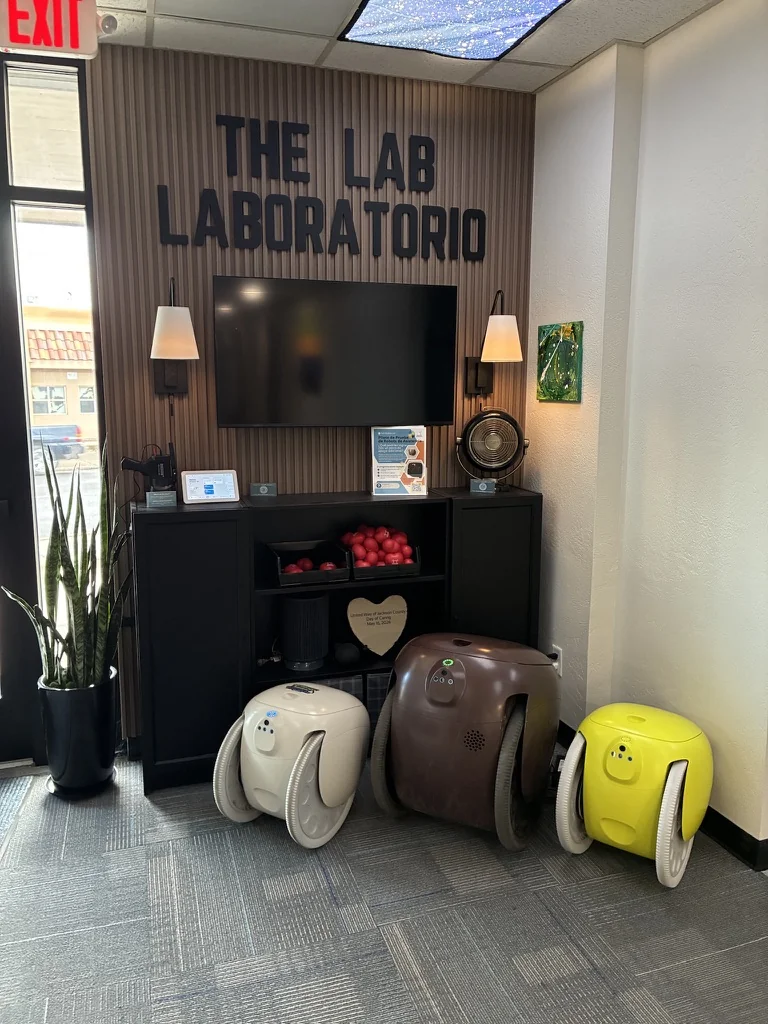
Staff named the first two robots Loppy and Coco. Loppy, a gitamini, can carry up to 20 pounds, while Coco, the larger gita, can carry up to 40 pounds. The bright yellow robot, named Lumi, is the latest addition to the robot crew.
Inside the tech lab
The Tech Lab is a place to explore technology, test ideas and discover what might be useful in people's lives. That can mean something as simple as using Amazon Alexa to control lights or fans with voice commands, or experimenting with a 3D printer to create customized solutions for individuals. It can also mean exploring newer technologies that offer different ways to navigate daily activities and community life.
For the past four years, Living Opportunities has been exploring the potential of gita service robots made by Piaggio Fast Forward (PFF). “We wondered if they could be an extra set of hands,” says David Van Hook, Living Opportunities' director of IT and tech solutions.
The robots follow their users while carrying belongings, offering extra support for activities at home or out in the community. The goal isn't to take over tasks or eliminate the need to manage belongings. It's to explore whether a robot can make certain activities easier and help someone focus more on the experience itself.
See the robots in action in this video from Piaggio Fast Forward, filmed during a visit to Living Opportunities in Medford.
Putting Technology to the test
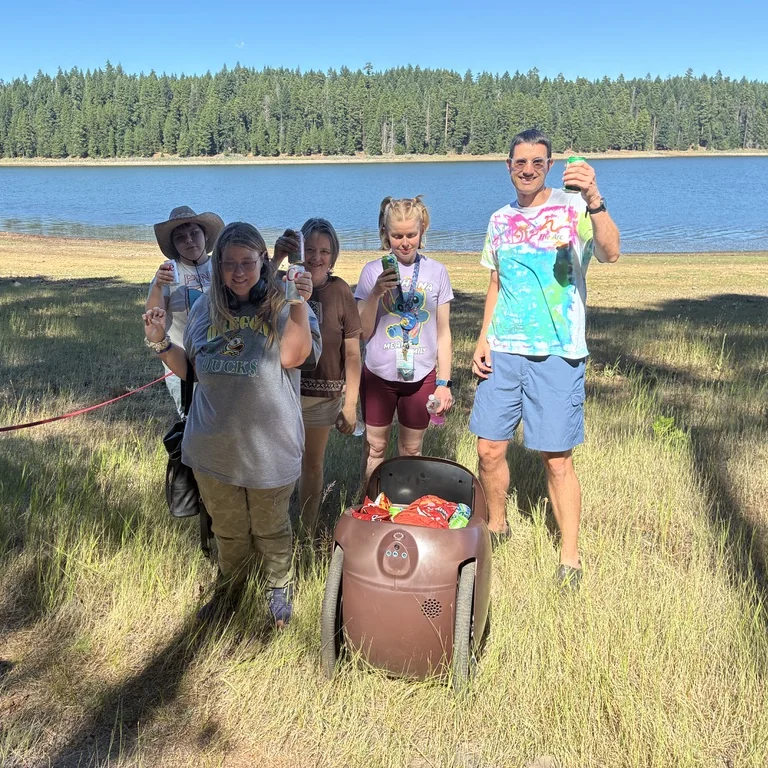
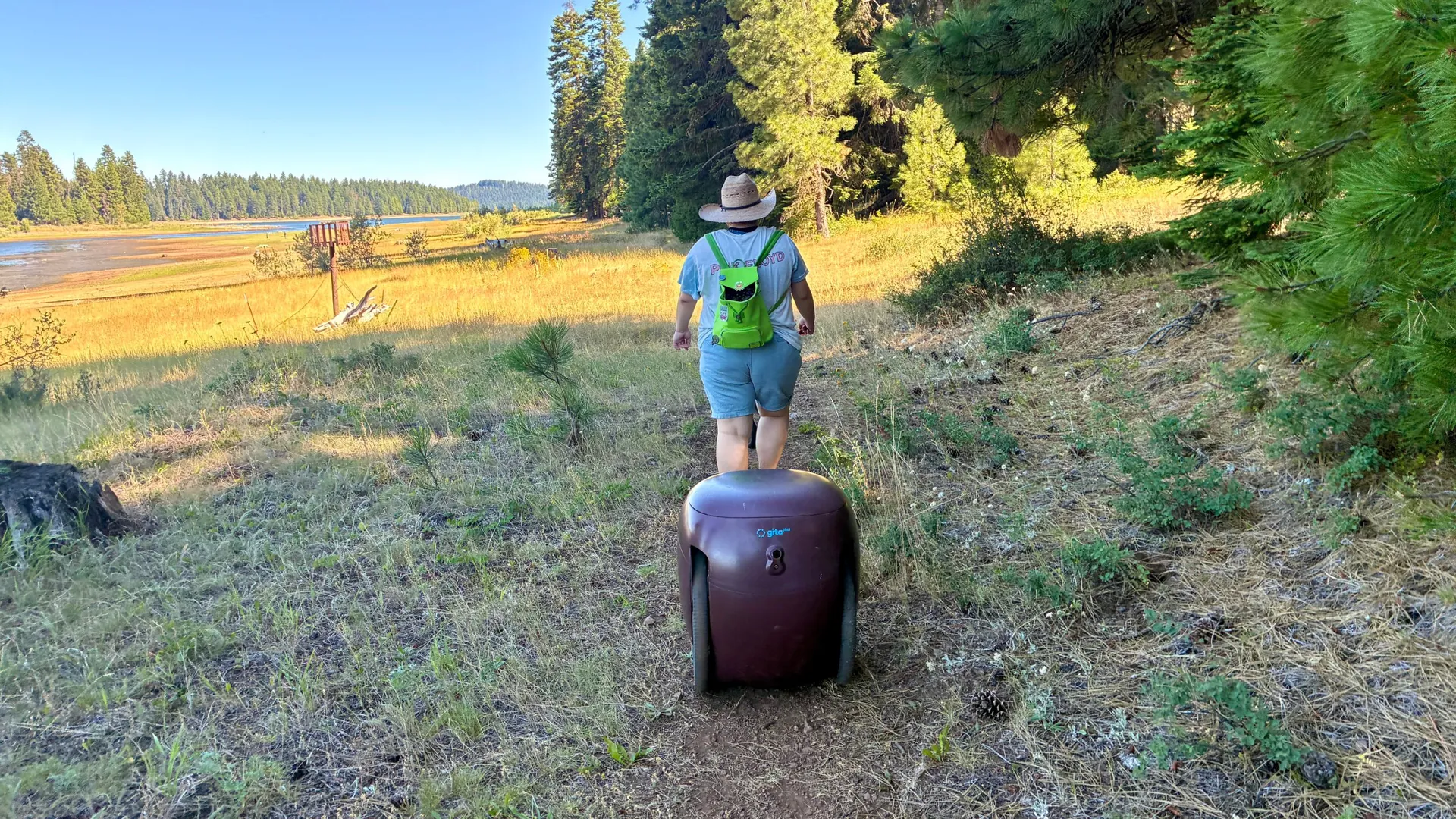
Coco carried snacks and drinks during a hike at Howard Prairie during Living Opportunities' annual summer camping trip.
“We're in Oregon. We have a lot of trails and a lot of outdoor spaces, and a lot of people like to be active,” Van Hook says. “People who otherwise would have to lug and carry their medication or extra support equipment can have a robot that will follow them around like an extra set of hands, so they can go out and enjoy their life.”
Living Opportunities has put that idea to the test on summer camping trips with Coco. The robot has carried gear from vehicles to campsites, snacks and drinks on a group hike, and fishing equipment to a pier. These outings offer a practical way to explore how the technology performs in real-world settings, including the outdoor activities that are an important part of life in Southern Oregon.
The robots may also offer useful insights about accessibility. Because they need many of the same conditions a wheelchair does, such as ramps, curb cuts and smooth surfaces, the places where they struggle can point to potential barriers along paths and building approaches. They are not a substitute for a formal accessibility assessment, but they can be another practical tool for increasing awareness.
The robots have also become ambassadors for the Tech Lab. “The robots are great brand ambassadors because they're great conversation starters,” Van Hook says. He estimates that about 75 percent of those conversations end with someone saying they know a person who could benefit from a tech solution, whether it's an aging parent who needs reminders or a friend who walks with a cane.
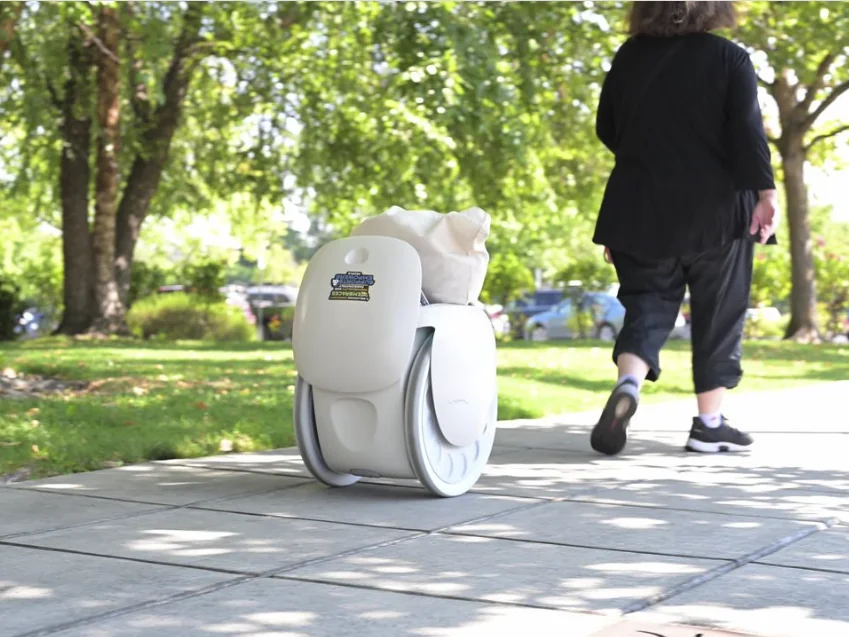
Rhonda is able to walk more comfortably with Loppy carrying her gear instead of a backpack.
Rhonda Smerdon of the Autism Society first encountered Loppy at a community event about three years ago. She immediately recognized the potential of the technology for people who have difficulty carrying or managing belongings.
Living with back pain, Smerdon also understands firsthand how having fewer things to carry and physically manage can reduce strain. For her, the potential is not about removing every challenge, but about finding tools that can make certain activities more manageable.
“I was like, that is a game changer. I can see where that’s going to break some barriers for folks.”
Rhonda Smerdon, Autism Society
Making Technology More Accessible
Trying new technology can be difficult when purchasing it is the only way to find out whether it works for you. The Tech Lab is designed to lower that barrier by giving people the chance to explore a tool before deciding whether to invest in it.
“The concept behind the Tech Lab is really affordability. A lot of people don't have the budget to just go and buy and test technology. Here in the Tech Lab, you get the opportunity to play with it and see if it's a fit before purchasing,” Van Hook says.
This summer, Living Opportunities launched a pilot program lending its robots to adults it supports and to families connected through its Bridging Communities Family Network. The program gives borrowers an opportunity to try a robot in their own lives and settings before making a purchase. Van Hook hopes to eventually expand the program to other agencies that support people with disabilities.
Ease of use matters, too. Technology is most helpful when people can learn to use it without an unnecessarily steep learning curve.
"It takes me all but five minutes to teach someone how to use it, which is great for people who really need something that just kind of works out of the box." — David Van Hook, Director of IT and Assistive Tech
A Growing Partnership
The partnership between Living Opportunities and PFF has grown through a shared interest in how technology can make a difference in people's lives. When the PFF team visited Living Opportunities in Medford, they wanted to see firsthand how the organization was incorporating the gita robots into its work and how the technology was benefiting the people it supports. That visit became the video featured above.
PFF has also donated two additional robots to Living Opportunities. One was auctioned at the organization's annual furnARTure fundraiser, where it sold for $2,500. The other, a gitamini, joined the Tech Lab, where staff named it Lumi.
For Living Opportunities, this work is part of a long tradition of looking for new approaches to support. Founded in 1974 by families seeking alternatives to institutional care, the organization has continued to explore ways to help people build lives shaped by their own interests, goals and choices.
Technology is one part of that effort, not a replacement for the relationships and personal support that make the work possible.
“Tech forward doesn't mean we're replacing support workers,” Van Hook says. “But we want to make sure we are keeping the individuals in mind, and technology can be a huge benefit for a lot of people.”
Not every tool will be right for every person, and a promising technology still needs to prove its value in practice. By creating opportunities to experiment, learn and share what works, Living Opportunities is helping people explore what's possible and keeping their needs at the center of the process.
See the Tech Lab for Yourself
Do you want to meet Loppy, Coco and Lumi? Inside Living Opportunities, a free monthly open house at the organization's Medford headquarters, includes a tour of the Tech Lab and its service robots, along with a look at how Living Opportunities supports people throughout Southern Oregon. Click here to learn more, or contact Lorie List at Lorie.List@livingopps.org to RSVP.
Learn More About Our Community
-
An Artist, a Collector, and the Story Behind Safari
The Spring Art Show was full of beautiful artwork, but some of the most meaningful moments happened in the genuine conversations between artists and the people who connected with their work. Here’s one we won’t forget.
-
He Helped Shape Who We Are
For 30 years, Doug has been part of the heart of Work Sharp’s production floor. A limited-edition knife created in his honor celebrates not just his work, but the culture of belonging and connection he helped build.
-
A Deep Breath: One Family’s Journey
When Sierra walked into her first Bridging Communities event, she didn’t know what to expect. What she found was a network of families who understood, and for the first time in a long time, she could finally breathe.